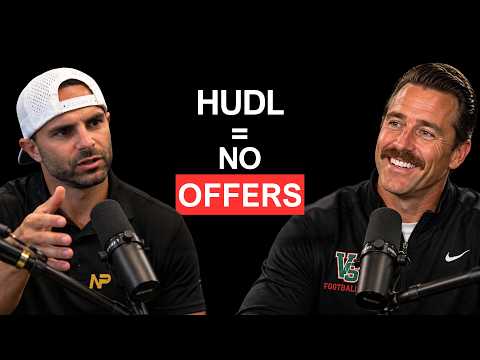
D2 College Coach Shares How to Get Recruited for College Football
Most parents think getting recruited comes down to film and physical measurables. A head college football coach with three national championships told me something different. In the first 10 minutes of a conversation, he already knows whether he wants your son on his roster. The tape got him in the door. What happens next determines everything.
Why Your Son's Film Is Just a Checkbox
I hear from parents every week who are obsessing over highlight reels. Editing order. Camera angles. Which plays to lead with. I get it. But Coach Parker said it plainly: the tape is a yes or a no. Can this kid fill a role? That's the only question it answers.
Once the tape checks that box, the evaluation is completely different. Frame. Work ethic. Intelligence. Coachability. Those are the things a college coach is deciding on when he picks up the phone or sits across from your son at a camp. The film got him to that moment. What happens in that conversation determines whether an offer follows.
If your son is spending all his energy on the highlight reel and none of it on how he communicates with coaches, he's preparing for the wrong test.
The 10-Minute Evaluation Every Coach Runs
Coach Parker told me he can figure out two things in the first 10 minutes of talking to a recruit: whether the kid is smart and whether he's a hard worker. Those are the only two traits that matter to him beyond the tape. Everything else is secondary.
Here's how he tests intelligence. He watches for humor. If a kid smiles, laughs, or makes a joke in the first five minutes, Coach Parker reads that as a signal. Smart people are funny. Smart people are relaxed. Smart people aren't stiff and scripted. A kid who loosens up in a conversation with a college coach is a kid who can process information under pressure on the field.
The work ethic test is just as simple. He asks about the weight room. Not in an aggressive way. Just conversationally. Your son says he's been working out. Coach Parker follows up: walk me through it. What are you hitting? Did you lift today? The kids who give a vague answer get crossed off. The kids who say they got four lifts in early in the week to stay fresh for the game, who say their clean went from 210 to 225 and they're now focused on their squat for explosiveness out of breaks, those kids turn his head. That level of specificity tells a coach your son is actually in the gym and actually paying attention to his own development.
What College Coaches Actually Think When They Read Your Son's Emails
I've said this before and Coach Parker confirmed it on this episode. Every recruit who sends an email says he's a hard worker. Every single one. Coaches laugh at that line now because it means nothing. Any kid can type it. It proves nothing.
The emails that get a response are the ones that prove it. Not claim it. There's a massive difference between "Coach, I've been working hard" and "Coach, I got four lifts in this week early so I could be fresh for Friday's game. I pushed my clean from 210 to 225 and I'm targeting my squat next because I want more explosion in and out of breaks." One of those emails gets deleted. One of those emails gets a response.
If your son's recruiting emails are full of generic claims and no specifics, he is invisible. Coaches are reading 50 emails a day from kids who all sound the same. The ones who stand out give a coach a real reason to want to know more. Specifics do that. Generalities never do.
Positionless Football and Why Parents Need to Let Go of the Position Conversation
One of the most useful things Coach Parker said in this episode was about how his program approaches positions. They play positionless football. He's had six different players take snaps at quarterback in a single season. One of those quarterbacks is now one of the best blockers on the team. Another is a starting receiver. Another is a top running back. The position listed on the transcript means almost nothing compared to where a coach can use a player to win games.
I get this question from parents constantly. My son plays defensive tackle in high school but he's really a linebacker in college. Should I send film? Send it. Coaches are recruiting players, not positions. They're looking for athletes who can fit their system and contribute on the field. A smart, athletic, coachable kid who trusts his coaches will play. A kid who insists on one position and won't budge limits himself before a coach even has a chance to evaluate him.
Coach Parker put it directly: if your priority is playing at the highest level possible, trust the coach. If your priority is playing a specific position you've decided on, you're going to limit your options no matter how talented you are. That's the truth.
Why Showing Up to Campus Changes Everything
Coach Parker told me every player he's offered since he's been at Davenport came to campus first. Not because it's a rule. Because it tells him something he can't learn from film or phone calls. A recruit who drives to campus, who walks the facilities, who meets the staff and gets around the players, that recruit is showing commitment. He's visualizing himself there. That's exactly the kind of buy-in a coach wants to see before he puts scholarship money on the table.
Most families wait for the offer before they consider the visit. That's backwards. The visit is often what triggers the offer. A coach who's on the fence about a prospect gets off the fence when that kid shows up. It answers the question every coach is really asking: does this kid actually want to be here?
If your son has a school he's interested in, stop waiting for an invitation. Find out when the staff is on campus. Email the position coach. Tell him your son wants to come see the program. Drive there. That one trip can do more for your son's recruiting than a month of emails from home.
What Grit Actually Looks Like to a College Recruiter
Coach Parker has coached players who went to Michigan, Iowa, and South Carolina. He's coached a Gene Upshaw Award winner, the best lineman in D2 football. He told me the thing those players had in common wasn't the most impressive film coming out of high school. It was grit. Hard work. The kind of mentality that shows up every Tuesday morning when no one is watching.
He said coaching a coach's kid is a reliable indicator because those kids grow up in the building. They know what hard work looks like because they've watched it their whole lives. That's not the only path, but it's the mindset he's looking for in every kid he recruits regardless of background.
The fifth-year walk-on who came in as the runt and put on 60 pounds to become a starter. That's the player development story that gets lost when coaches chase the portal and stop recruiting high school kids who need time to develop. If your son is a player coaches are overlooking because the tape isn't perfect yet, find a coach who believes in development. Those coaches exist. Coach Parker is one of them.
Join the Free Live Workshop
If you're a parent trying to figure out how to help your son get in front of college coaches, this is where to start. I run a free live workshop where I walk through the exact recruiting system that helped me earn a D1 scholarship in the SEC at 5'7" and 150 pounds, and that 83% of the athletes I work with use to land scholarship offers.
Register for the free live workshop at gonextplay.com/free-training.