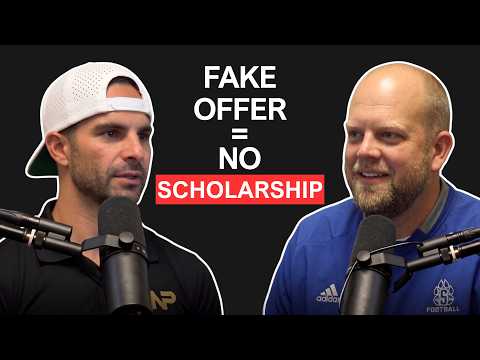
Head College Coach Reveals How to Get A Scholarship Offer
Most families walk into the recruiting process focused on the wrong things. I sat down with a Head College Football Coach who has spent years developing players at the college level, sending guys on to professional opportunities, and watching parents make the same costly mistakes over and over. What he shared about how offers actually work, what coaches are really evaluating, and why the recruiting timeline is nothing like what most families assume will change how you approach this process starting today.
What College Coaches Actually Care About During Recruiting
I asked him straight up: what are families usually focused on during the recruiting process that coaches just don't care about as much as they think? His answer was immediate. Going pro.
He told me that when a family walks in with their number one goal being the NFL, they're already looking at it from the wrong angle. He said it plainly. His job is to bring your son in, get him a degree, and send him out as a good man. The football experience is the vehicle. The degree is the destination. Every single player who has gone on to play professionally from his program had one thing in common: a GPA of 3.79 or higher, zero missed classes, zero missed meetings, and extra work put in on their own time.
That's the recruiting profile that actually leads to professional opportunity. Parents who push the pro conversation as the primary pitch are unintentionally signaling to a coach that their son isn't ready for the work required to even have that conversation four years from now.
The Commitable Offer Problem Nobody Talks About
One of the most important things I teach players is this: when a coach offers you, ask immediately whether it is a commitable offer. Most parents have no idea this question even exists.
Here's what happens without it. Your son gets an offer, locks in emotionally, tells his friends, starts imagining his future there. Then he calls to commit and the coach says, "We appreciate you, but you're sixth on our board right now." That moment is devastating. And it is completely avoidable.
The coach I interviewed is direct about this. When his staff puts an offer out, they are prepared for a yes. They have watched every piece of film as a full staff. They have agreed internally that this player is someone they want in their program. If they reach a point where the roster is full, they simply stop offering. No games, no stalling. That kind of honesty is rarer than it should be, and it is exactly what your son needs to look for when he is evaluating who to trust with the next four years of his life.
How to Actually Get Your Film in Front of a College Coach
This coach is straightforward about his recruiting contact preferences. He uses X, which is what most people still call Twitter. Follow the coach, get a follow back, send a direct message with your film and your GPA. That combination. Film and GPA together in the first message. Not just a Hudl link. Not just a name.
He made a point I want every parent to hear. He does not want to recruit a player for two months and then find out the GPA is too low to get into school. That wastes his time and your son's time. Send the GPA upfront. Lead with it. A strong GPA signals to a coach that your son goes to class, does what he's told, shows up when it's hard, and won't disappear the first time things get difficult in a college environment.
Email works too, depending on the coach. Some coaches run their entire operation through email. Others, like the one I interviewed, will go two days without opening their inbox. The answer is to do both. Hit the DM. Send the email. And if you really want to separate your son from every other recruit in that coach's pipeline, get him on the phone. Every coach I have ever talked to says the same thing. A kid who picks up the phone and talks is a kid they recruit harder.
Understanding the Difference Between NAIA, D2, and D3
A lot of parents are confused by the division system and I don't blame them. The coach I sat down with broke it down in a way that I haven't heard anyone explain quite this clearly before.
He said private D2 schools and NAIA schools are far more similar than most families realize. Similar campus size, similar class sizes, similar scholarship structures, similar talent levels. The public D2 schools, the larger state institutions, are a different animal entirely. Some of them would compete favorably with FCS programs. But the smaller private D2 schools and solid NAIA programs are playing the same game at very similar levels.
What he sees happen too often is a family drops an NAIA school the moment a D2 offer comes in, simply because D2 sounds more familiar. He doesn't say this to knock D2. He says it because the label alone is not a reason to make a four-year decision. The real questions are: Is this coach going to take care of my son? Will someone check on him when things get hard? Does this program graduate its players? Those answers matter more than the acronym on the letterhead.
Why the Recruiting Timeline Is Not What You Think
Parents call me in February convinced that recruiting is over. Signing day has passed and they think the window closed. I have to stop them every time.
The coach explained something that every parent of a high school football player needs to understand. Programs at the NAIA and D2 level are still filling spots well into spring and sometimes into summer. The trickle-down effect is real. Power Four programs cap their rosters. The overflow goes to FCS. FCS overflow goes to D2. D2 overflow goes to NAIA. That chain takes months to play out.
He also noted that because of roster limits and the five-year eligibility rules changing the landscape at higher levels, his recruiting cycle is actually moving earlier than it used to. Spots at his level are filling up faster. So if your son has NAIA or D2 level film and he's waiting until spring to make his move, he may be waiting too long. The families who file the FAFSA early, send outreach consistently, and stay in communication with coaches through the fall and winter are the ones who end up with the best options when spots open up.
The Game Day Visit and What It Actually Tells You
The coach talked about something that I think every family underestimates. Getting on campus for a game day. Not just a campus tour. A real game day, when the team is playing, coaches are coaching under pressure, and the players you'd be with for four years are reacting to adversity in real time.
He said that is where you learn who a program actually is. Parents groups are there. Current players are there. No one is putting on a performance for you. Ask the players what they think. Ask the parents in the booster section about their experience. A coach can rehearse a recruiting visit. Parents and players on a random Saturday cannot.
His staff actively sends recruits and their families over to the parent booster group during game days. They want those conversations happening without a coach in the room. That level of transparency tells you something. If a program does not want you talking to their current families without supervision, that tells you something too.
Join the Free Live Workshop
If your son is working through the recruiting process right now and you want a clear system for getting his film in front of coaches at the right level, I cover all of this in my next live workshop. We walk through how to identify the right schools, how to reach out, and how to build the kind of recruiting profile that gets a coach to stop scrolling and pay attention.
Register for the free live workshop at gonextplay.com/free-training.