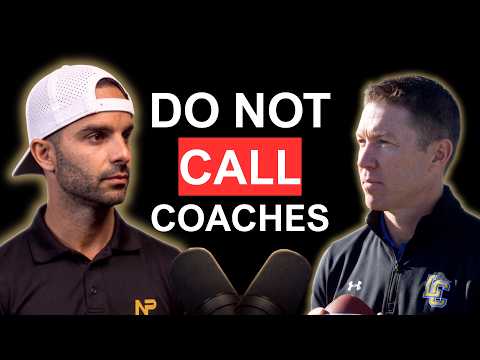
Head D2 Coach Shares How to Get Recruited When You Are Unknown
Most football families are waiting to get discovered. A Head College Football Coach told me flat out: he does not believe the old saying that if you're good enough, coaches will find you. Seven minutes into our conversation, he estimated 29 new recruiting emails had already hit his inbox. Good players slip through every single day. Not because they aren't talented enough. Because nobody taught them how to get in front of the right people.
Why "If You're Good Enough They'll Find You" Is a Lie for 99% of Players
I hear this all the time from parents. Their son is the best player on his team, maybe one of the best in his district, and they're sitting back waiting for the phone to ring. It never rings.
The truth is that advice applies to roughly 300 players out of 1.1 million high school football players in this country. Those 300 kids are already known by every major program before they ever send a single email. Big-time programs have backend recruiting services most families have never heard of. Those kids are already being offered. They don't need a polished X profile or a well-written email because coaches are already in their living rooms.
Your son is not one of those 300. Neither was I when I played. And that means the responsibility to get in front of coaches falls entirely on him and on you. Waiting is not a strategy. It is how good players get passed over.
The Four T's Every College Coach Is Evaluating Your Son Against
Coach Softley laid out exactly what UTPB looks for in every recruit. He calls them the four T's: Talent, Toughness, Teachable Spirit, and Team Commitment. Every player your son is competing with for a roster spot gets run through these same four filters.
Talent is non-negotiable. You have to be able to play. That part is obvious. But coaches at the D2 and FCS level see hundreds of players who can play. So once your son clears that bar, the other three T's become the deciding factors. Can he handle adversity and prosperity without cracking? Is he willing to be coached hard and grow, or does he push back? And when the locker room gets hard, does he stay or does he find an exit?
Here is what parents miss. Those last three T's show up in recruiting before your son ever sets foot on campus. The way he responds to a coach's email is a toughness test. The way he fills out a recruiting questionnaire is a teachable spirit test. The way he follows up week after week is a team commitment test. Everything is a test. That was said directly on this podcast, and it is exactly right.
How to Get on a Coach's Radar When You're Unknown and Your School Has No Connections
This is the question I get from parents in smaller towns and rural programs constantly. Your son has the film. His high school coach either doesn't advocate well or doesn't have relationships with college staffs. How does he break through?
Coach Softley was clear. Eliminate every piece of friction in the recruiting process. Get the NCAA ID. Set up the paid account. Have transcripts ready. Make sure your phone number and your parents' contact info are accessible so a coach who finds your son's film can reach someone immediately. When a college coach finds a player who looks interesting and then hits a wall trying to get basic information, that player gets passed. There are 29 more emails waiting.
Beyond eliminating friction, your son has to reach out directly and do it the right way. Reference the program. Reference the coach's background. Be specific. Then follow up in the same email thread, one week apart, every week. A coach who sees four follow-ups stacked in one conversation knows something about that kid's character before he ever watches a snap of film.
What Happens After a Coach Notices Your Son's Film
Getting noticed is step one. What happens next is where most families fall apart.
Coach Softley described it this way. A coach sends a recruit a link to fill out. The recruit doesn't fill it out. That was a test and he failed it. Now the coaching staff has to decide whether his talent is worth fighting through the friction of working with someone who doesn't respond, or whether they move on to the next player on the list. At the D2 and FCS level where roster spots are limited and dozens of players are comparable in ability, a non-response almost always means a pass.
When your son does get that first call or that first email from a college coach, treat it like a job interview. He said yes sir and no sir. He had questions ready to ask. He was engaged, confident, and humble at the same time. Coach Softley put it this way: when you get one offer and you kill that first interview, offers multiply. One coach found your son. Seven coaches are about to. But the first impression only happens once.
The Transfer Portal Reality Every Family Needs to Hear Before Chasing It
A lot of families I talk to now view the transfer portal as a safety net. Their son gets somewhere, it doesn't work out the way he hoped, and they figure the portal will fix it. Coach Softley gave me the data that should change that thinking entirely.
Two-thirds of players who enter the transfer portal at the D2 level do not find a new home. Of the third who do land somewhere, two-thirds end up at or below the level they left. And on top of that, players lose an average of 30 percent of their credits when they transfer. Nobody is talking about the graduation rate consequences. Coach Softley was direct about it and he is right that this information needs to reach families before their son makes a decision in the middle of a frustrating sophomore season.
The better play is to pick the right fit from the start. Choose a program where your son can develop, get reps, and play for coaches who actually coach football. UTPB sent four players to Power Four programs last year and has a player currently with the Jaguars. That path starts with choosing the right place, not the biggest name. As Coach Softley said about a player he knew who turned down Oklahoma to go to a smaller school: it wasn't the smaller decision, it was the better one. He became a two-time All-American.
What "Do the Things That Take No Talent" Actually Means for Your Son Right Now
Coach Softley said this and I want every parent reading this to sit with it. Do the things that take no talent. Be sharp with those.
He wasn't talking about running faster or getting stronger. He was talking about responding to emails within hours, not days. Filling out the questionnaire the day it arrives. Writing a thank-you note after a camp. Being on time. Showing up to a phone call with questions already written down. These are the actions that require zero athletic ability and yet separate the players who get recruited from the ones who don't.
At the D2, FCS, and Group of Five level, coaches are looking at players who are all close in ability. When two players are nearly identical on film and in the weight room, the one who answered the email the same day wins. That is not an exaggeration. That is how roster decisions get made. Your son can control every single one of those actions starting today.
Join the Free Live Workshop
If your son is a high school football player and you're not sure where to start with recruiting, or you've started and aren't getting responses, I break down the exact system inside my next live workshop. We cover how to contact coaches the right way, how to get your son's profile set up so coaches can find him and reach you immediately, and how to build real relationships with programs that are a genuine fit.
Register for the free live workshop at gonextplay.com/free-training.