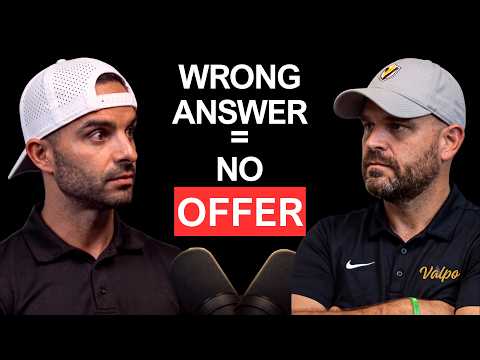
D1 Head Coach shares how to get committable scholarship offers
Most parents think an offer is an offer. A D1 head coach sat down with me and explained exactly why that assumption is costing families the recruiting process before it even starts. What you think is a scholarship offer may not be something your son can actually commit to. And if you do not know the difference, you are flying blind.
The Difference Between a Real Offer and a Non-Committable Offer
Coach Waddle was direct about this. A lot of offers that go out are non-committable. What that means in plain language is a coach is saying, "We are interested. We are going to keep evaluating you." That is not an offer your son can accept. It is a placeholder that programs use to hold a recruit's attention while they keep shopping.
He told me families find out the hard way at the end of the season. Their son had three or four offers on paper. He tried to commit to one of them. The coach said it was not on the table anymore. Now it is February and he has nothing.
The fix is simple and your son needs to do this every single time. When a coach extends an offer, ask one question directly: "Coach, is this a committable offer?" That question does not hurt your relationship with the program. It protects your son's future. Coaches who make real offers respect the ask.
Who Is Making the Offer Matters as Much as the Offer Itself
Coach Waddle made a point that most families never think about. The person extending the offer tells you almost everything about how real it is. If the head coach is on the phone making the offer, that carry weight. If it is the coordinator who coaches your son's position group, that is also meaningful. If it is a graduate assistant who watched your son run a 4.54 at a camp and immediately called, that offer has a very different shelf life.
Programs move offers around. They extend them. They pull them. Especially at the FBS level, classes fill from the top down. Big Ten and SEC programs close their classes first. Then the Big 12 and ACC. Then the Group of Five. Then the FCS programs. So a non-committable offer from a Power Four program in June may evaporate by November, and the FCS window your son could have secured in September is now gone too.
I always tell families: find out where your son grades out right now as a prospect, then spend the bulk of your time building real relationships at that level. A committable offer from the right program beats ten non-committable offers from programs that were never serious.
Why Walk-On Offers Carry More Risk Than They Used To
This is the part of the conversation that every parent of a senior needs to hear. The roster rules at the Division One level changed. Programs used to be capped at 110 players in preseason camp, and after camp they could add walk-ons. Now there is no preseason roster limit. A school can bring 150 players to camp and then cut down to 105 when the season starts.
What that means for your son is real. A program can offer him a walk-on spot, bring him through a month of preseason camp, evaluate him like a try-out, and then cut him when the season begins. His eligibility clock has already started the moment he enrolled full-time. He cannot transfer to another Division One program at that point. He is stuck.
Coach Waddle was clear that Valparaiso is not doing this. But he also told me it is happening out there right now. If your son is being offered a walk-on spot at a big program, you need to ask the same question you ask about any offer: is this guaranteed? What happens if he does not make the final 105? Get those answers in writing if you can. Walk-on spots used to be a legitimate path. Right now, some of them are month-long try-outs with no safety net on the other end.
What a D1 Head Coach Actually Looks for at Camp
Coach Waddle said fit is the first thing he evaluates. Not just scheme fit. Personality fit, culture fit, and institutional fit. He wants to know if a recruit's values match the environment his program is building. He coaches his assistants to look for the same things because "gut feel" is not enough to build a roster on.
The signs he notices at camp are straightforward. Is the kid locked in when a drill is being taught? When he makes a mistake, does he fix it or repeat it? Does he attack every rep with energy? Does he take coaching without sulking? Those things tell a head coach more about what a player will be like on a Tuesday morning in January than any highlight tape.
He also told me he values multi-sport athletes. He values kids whose parents played college sports because those families already understand the commitment. And he values players from his program's geographic footprint, though he recruits nationally. If your son is going into his senior year without offers, going to camps at schools that actually fit his level is not optional. It is the work. Coaches make offers to guys they have evaluated in person. That is not a coincidence.
The Value Proposition of a D1 Non-Scholarship Program
Coach Waddle coaches in the Pioneer Football League, a Division One FCS conference that does not offer athletic scholarships. When he told me that, I asked him to explain what families actually get. He walked me through it.
His players are on ESPN every week. They face Division One competition. They have access to Division One academic support, strength and conditioning, and nutrition resources that do not exist at the lower levels. And he had multiple players leave his program last year and land at Power Four schools. One started at USC. One is set to start at Boston College. Those players were not at a stepping stone. They were playing Division One football and developing at a Division One level.
He described three types of families in recruiting. Families where money is not a factor. Families where money is the only factor. And the majority of families who live somewhere in the middle, where the best experience at a price that makes sense wins. His pitch to that middle group is real. You are not settling. You are making a smart decision about where your son can be important, impactful, and set up for life after football. That calculus matters more than the logo on the helmet.
Join the Free Live Workshop
If your son is navigating offers right now and you are not sure which ones are real, or if he is heading into his senior year without the traction you expected, the recruiting process is not over. It is just getting to the point where the right move in the next 60 days determines everything. I break down exactly how to evaluate your son's film, target the right level, and build real relationships with coaches who can actually put him on the field.
Register for the free live workshop at gonextplay.com/free-training.