How to Earn A Scholarship At A Recruiting Camp
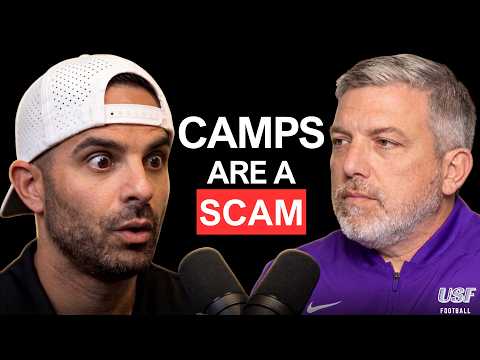
I sat down with a Head College Football Coach who has spent 30 years in college football and 12 as a head coach. He broke down exactly what happens at recruiting camps, what coaches are watching the entire time your son is on that field, and the one mistake families make that quietly ends a recruiting conversation before it ever starts. If your son is planning to attend camps this summer, this conversation changes how you prepare him.
What Coaches Are Actually Evaluating at Recruiting Camps
Most families think the camp is about the 40 time and the vertical jump. Those numbers matter. They help coaches filter a list of thousands down to something manageable. But the coach I spoke with told me something most recruiting consultants never say out loud: by the time your son shows up to camp, the physical testing is almost secondary.
He watches how your son handles being corrected. When a coach walks up and says do it again, does your son reset and go harder or does he drop his shoulders and look at the ground? That response tells a coach more about who your son is than any combine number. He told me coaching is about getting a kid to reach his full potential, and the things that block that potential are almost never physical. They are character issues that the recruiting process never officially tests for.
He also watches how your son acts between reps. How he talks to you in the parking lot after a hard session. Whether he throws his sweaty shirt at you and asks where his Gatorade is, or whether he comes over and acts like a young man you raised right. Coaches see all of it. The camp is a six-hour window into exactly who your son is when he is tired, hot, and competing against players better than the ones he faces on Friday nights.
How to Choose the Right Camps to Attend
Parents ask me all the time which camps their son should go to. The answer is simpler than most people make it. Go to camps where a coach has already seen your son's film and has shown real interest. Not a mass camp invite. Actual interest. A coach who has watched your son's highlight video and reached out is a completely different situation than a school that emailed every player in a five-state radius.
The coach I interviewed was direct about this. In his region, every D2 and FCS program in the conference shows up to the same two or three major university camps every summer. He goes to South Dakota State, North Dakota State, North Dakota. He sees hundreds of kids in one day. He already knows the 10 or 15 guys he is there to evaluate. If your son is not already in communication with that staff, showing up cold at a major camp is a long shot.
The camp that actually matters for your son is the one hosted by the school recruiting him. That is where a coach is watching specifically to confirm the offer he already wants to extend. He coaches your son directly for three hours. He sees how your son responds to instruction from the guy who would actually be coaching him on Saturdays. That camp is the final step toward an offer, not the introduction.
What Kills a Recruiting Visit Before It Starts
I asked him what parents and players do during official visits that quietly takes them off a board. He did not hesitate. He talked about the small things that most families never think about because no one in recruiting ever tells them these details matter.
Does your son push his chair in after lunch? Does he pick up his jersey off the locker room floor or leave it in a pile? If dinner is at seven and the family rolls in at seven ten, that coach noticed. If your son is on his phone during the campus tour instead of engaging with the position coach standing right next to him, that coach noticed. These are not trick tests. They are just what coaches see because they are watching your son the entire time, not just during the football portion of the visit.
He told me the same rule applies to how your son communicates during the process. A kid who gets a camp invite, says he cannot make it, and sends no follow up is telling that coach something. The kid who says coach I have a baseball game that afternoon but I can drive straight there after and be on campus by six, that kid is telling a completely different story. Your son's actions during the recruiting process are the preview of how he will compete when no one is watching in January when the coaching staff is not in the building.
What Parents Do That Hurts Their Son's Chances
This part of the conversation was important for every parent listening. When you are in a coach's office and you answer questions for your son, you are not helping him. You are hurting him. The coach I spoke with told me directly: he invited your son into that room because he sees something in him. He does not need you to sell him. He needs to hear your son speak for himself.
The ability to advocate for yourself is one of the most important skills college football teaches. At the scholarship level, your son will eventually have to walk into that coach's office alone and make a case for a scholarship increase. No parent in the room. Just him and the coach. If he has never had to speak for himself during the recruiting process because you handled every conversation, he is not ready for that moment.
Let your son lead. Let him answer the hard questions. Let him ask the follow up when he does not understand something. Your job on that visit is to ask the questions that actually protect him. Who stays with my son if there is a serious injury eight hours from home and the team bus has to leave? Who advocates for him if he ends up in the dean's office? Those questions tell you more about a program than any depth chart conversation ever will.
How Senior Film Fits Into the Camp Evaluation
The coach I interviewed said something that surprised a lot of people in our audience when I shared a clip from this conversation. He said senior film is often an afterthought. Not because film does not matter, but because by the time a kid is in serious conversations with a staff, that staff has already seen him live at two or three camps against real competition in real conditions.
Film is the filter that gets your son on a board. It is how coaches narrow thousands of prospects down to the ones worth watching in person. But once your son is on that board and coaches have seen him compete against a linebacker from Minnesota and a receiver from Omaha on the same afternoon, a highlight video edited to show only his best plays tells that coach very little he does not already know.
This is why the communication before a camp matters so much. Your son needs to reach out to coaches at the programs he is genuinely interested in before camp season starts. Make sure they have watched his film. Confirm there is interest. Then when he shows up at that camp, he is not one of five hundred anonymous kids. He is one of fifteen that a specific coach drove three hours to evaluate. That is a completely different experience, and it leads to completely different outcomes.
Join the Free Live Workshop
The recruiting process is moving faster than most families realize. Coaches are building their boards right now. If your son does not have a clear plan heading into camp season, he is already behind the families that do.
I run a free live workshop where I walk parents through exactly how to position their son to earn scholarship offers using the same system that helped 83% of the athletes I have worked with land offers. We cover film evaluation, how to reach out to coaches the right way, and how to turn a camp appearance into an offer conversation.
Register for the free live workshop at gonextplay.com/free-training.